Practice makes perfect: 29 practice exchange student interview questions and answers

Since I wrote it in late 2016, my article giving advice on student exchange interviews has become the most popular page on this website.

Soon after I’d written it, about 200 people per week were logging on to get my advice on how to outperform the competition in their student exchange interviews.

This post aims to help those people even more, by giving 29 practice questions and answers of a kind that could be used in a student exchange interview.

Bolzano - Exchange Student Tips
Bolzano, Italy (Photo: Jim Hedd/Flickr)

Short disclaimer

Unfortunately, I can’t guarantee that the selection panel which interviews you will ask any of the questions which follow. Indeed, they might ask you a totally different bunch of questions.

What I can say is that these are the type of questions which a selection panel will probably ask you. Working your way through these questions will help you to think about the general topics which you’ll talk about in your interview.

<script async src="https://pagead2.googlesyndication.com/pagead/js/adsbygoogle.js"></script>
<ins class="adsbygoogle"
     style="display:block; text-align:center;"
     data-ad-layout="in-article"
     data-ad-format="fluid"
     data-ad-client="ca-pub-8474463762456588"
     data-ad-slot="6322902010"></ins>
<script>
     (adsbygoogle = window.adsbygoogle || []).push({});
</script>

How to use this page

I’ve set this page up in a kind of question and answer format. The questions are given in bold text. My notes about how to answer are below each question in normal text.

To train up for your interview, I suggest that you do the following:

Begin by finding a quiet and private space where you can talk aloud.

Then, interview yourself. First, read out each question to yourself aloud. Then, close your laptop or put down your phone and answer the question out loud, as you would in an interview.

Answer all of the questions. Talk in complete sentences and answer each question as fulsomely as possible. Answering all of the questions should take you at least a couple of hours. By the time you’ve answered all 29 questions, you should be exhausted.

Is interviewing yourself in this way kooky? Sure. However, for whatever reason, you usually perform better in an interview if you’ve previously answered the questions the panel is asking you. Interviewing yourself should make you more confident and relaxed going into the interview. Try it.

Here we go:

Ice breakers

1 – Why are you interested in going on exchange?

Purpose: Mainly an ice-breaker to get you talking and ease your nerves, but could also be probing to ensure that you aren’t applying on a whim or under pressure from your parents.

Response: Be truthful and upfront about your reasons for applying.

Your background

2 – Please tell us about yourself.

Purpose: Ice-breaker and to get to know whether you’re the type of person whom the panel thinks would make a good exchange student

Response: Talk about your family, your school, and likes and dislikes. But don’t ramble – one or two minutes total should be fine.

3 – Have you lived overseas previously?

Purpose: Living overseas can be difficult due to homesickness, culture shock, feelings of isolation and so on. If you’ve already done it and lived to tell the tale, you most likely can do it again.

Response: If you’ve done it, tell the panel about it. It’s OK to admit that you were a bit homesick or had culture shock, provided that you explain and emphasise how you overcame those challenges.

4 – What is the longest period you’ve previously spent apart from your biological family? Did you suffer from any homesickness?

Purpose: Similar to question 3, the purpose of this question is to determine whether you can deal with being away from your family for extended periods.

Response: Again, if you’ve done it and had some homesickness, it’s OK to admit this, provided you can also talk about your strategies for dealing with the homesickness.

5 – What do you hope to get out of being an exchange student?

Purpose: Again, to determine whether you’re applying to go on exchange for good, positive reasons, and whether you’ve thought about the pluses and minuses of being on exchange.

Response: You most likely have a number of motivating factors, but try to focus on the ones which accord with the aims of the exchange program.

6 – Do you think you’d make a good exchange student? If so, why?

Purpose: To test your self-awareness and to give you an opportunity to “sell yourself” a bit, by talking about some of your positive attributes

Response: Generally, exchange organisations are looking for students who are resilient, motivated and willing to assimilate, so try to think of some situations in which you’ve demonstrated those qualities. Although you should talk about your positive qualities and why they’d make you a good candidate to go on exchange, be sure also to mention a new situation which you found difficult or which tested you, and what you did to overcome those difficulties.

Your attributes

7 – What are your greatest achievements? Please tell us about one.

Purpose: To find out some of your good qualities and what you’ve achieved in the past. Arguably, someone who has overcome a lot of challenges or achieved great things previously is more likely to be a successful exchange student

Response: If possible, try to think of an example in which you overcame a significant obstacle or really had to persevere and work hard to get an outcome, rather than something that you achieved because of natural talent. For example, being picked to play on the school football team is impressive, but a selection panel will likely be more impressed by the story about how you had a significant injury and had to really work hard to re-habilitate yourself, regain your fitness and be back on the team.

8 – What do you rate as your greatest personal strengths and weaknesses?

Purpose: To enable you to sell yourself, but also (more importantly) to let the panel see how self-aware and honest you are

Response: Don’t go too hard on your strengths, or you may come across as arrogant. Mention one or two of your weaknesses (to show that you’re aware of them) and what strategies you employ to overcome them. For example, say “I can sometimes be a bit shy around people I don’t know very well, but I make a really big effort to approach people and try to get to know them”.

9 – As an exchange student, you’d be an ambassador for your home country. Do you think you’d be a good ambassador for your home country? If yes, why?

Purpose: The “diplomacy” aspect of student exchange is very important. The panel wants to make sure that you’re aware of this aspect, and will be interested in hearing about any relevant previous experience.

Response: If you’ve previously lived overseas or had any “official” or representative role (school captain, sports team captain) mention this here.

10 – Have you ever broken the law? If yes, please give details.

Purpose: Breaking the laws of another country can have serious consequences, including imprisonment and (in the case of narcotics offenses in some countries) capital punishment. Exchange programs like to know that the people they are sending abroad are law-abiding.

Response: Answer honestly. If you have broken the law previously, be sure to talk about how regretful you are and how you’ve learned from the experience.

Background knowledge

11 – What can you tell us about Rotary/AFS/the exchange organisation you’re applying for?

Purpose: To check whether you’ve done your homework and how motivated and interested you are to go on exchange with the relevant exchange organisation

Response: Mention a few key facts

12 – What is the capital of your intended host country?

Purpose: To find out your level of interest in your intended host country, as well as the depth of your general knowledge, overall.

13 – What is the name of the currency of your intended host country?

Purpose: As above

14 – Who is the governor of your state and the mayor of your home town?

Purpose: To find out the depth of your general knowledge and how interested you are in current / civic affairs

15 – Name three big companies who are headquartered in your home country and/or your local area.

Purpose: To find out the depth of your general knowledge about your home country and/or town. People overseas can often ask questions about the economic or social aspects of your home country; exchange organisations like to know that the people they are sponsoring to go on exchange have at least some knowledge of these issues.

Resilience and judgement

16 – Exchange students usually encounter a range of situations which test their resilience. Please share an example of where you were in a difficult situation. What did you do to cope with the situation and/or get out of it?

Purpose: To enable you to demonstrate your ability to come with, and overcome, adversity

Response: If possible, give an example about a situation where you couldn’t fall back on your family or close friends, to demonstrate you’re capable of overcoming adversity by yourself (as will be the case when you’re on exchange)

17 – If you had a problem with your host family, what could you do to resolve it?

Purpose: To test the appropriateness of your judgement and your ability to solve problems appropriately

Response: If it were a small, day-to-day matter (for example, a host sibling taking your things without asking), you could raise the issue with your host parent or with the sibling directly. If it were a bigger issue (for example, your host family breaking the law), you would need to talk to someone in your exchange organisation.

18 – What would you do if a teacher at school in your host country asked you to do something that you didn’t feel comfortable doing?

Purpose: Again, to check that you are able to act appropriately in a difficult situation, and understand the role that your host family will play

Response: Your first port of call in relation to school issues is your host family – mention that you would talk to your host parents first

19 – What would you do if your host brother or sister showed a romantic interest in you? Assume that you find him or her very attractive.

Purpose: To check your judgement in a difficult situation

Response: The best rule is never to have a romantic relationship with a host sibling until your exchange is over. The reason is that if the relationship goes bad, you will be living together with your ex boy- or girlfriend and his or her parents – who will never be on your side. Can you say “awkward”? So, you will always have to say no to any such attention from your host siblings.

20 – Assume that cannabis had been decriminalised in your intended host country. If your host brother offered to share a joint with you, would you agree?

Purpose: To check your judgement in respect of behaviour which is not illegal, but which may not be a good idea

Response: Just say no. Even if consuming cannabis is not illegal, you are more likely to have impaired judgement and act dangerously or in an offensive way if you are under the influence.

School life

21 – Have you had any leadership roles at your current school?

22 – Are you involved in any co-curricular activities at school – for example, sport, band or debate club?

23 – What is your GPA/what are your grades like?

24 – What are your plans for life after school?

Purpose: These are all questions designed to find out information about your background and your suitability to be an exchange student. Generally, the more you can show that you are a diligent, good-citizen student who works hard, the more attractive you will be as a candidate.

Choice of host country

25 – Why are you interested in doing an exchange in your chosen country?

Purpose: To test your motivation for going to a particular country. Are there certain drivers or “pull factors” which make you interested in your first-choice country (for example, an interest in a particular language or part of that country’s culture)?

Response: Be honest. An exchange organisation may be slightly suspicious of a student who can’t say why he or she is interested in living in a particular country, so try to think of at least a couple of things which interest you about your intended host country

26 – Would you be willing to go to another country if you didn’t get an offer from this exchange organisation for your chosen country?

Purpose: Competition for certain countries (such as Spain and Germany) is typically very high. The purpose of this question is seeing whether you’d be open to going to another country if you don’t get your first choice.

Response: Be honest. If you have your heart set on going to Spain, don’t say that you’d be willing to go to Mexico – odds are that you’ll get sent to Mexico. It’s OK to say that you want to go to Spain, and if you aren’t offered Spain, you’ll try again with another organsation.

27 – Are you willing to learn the language which is spoken in your chosen host country? Have you already taken any steps to learn that language?

Purpose: Learning the language of your host country is a huge part of going on exchange. Every exchange organisation will want you to learn the language, and learn it well. Any steps you’ve already taken to learn a language should work in your favour.

Response: You need to confirm that you are willing to learn the language spoken in your host country, and that you will work hard at it.

28 – Would you have any problem with being placed in a small, isolated town in your host country, in a rural or remote area?

Purpose: Many people going on exchange imagine themselves going to, and living in, big cities. They imagine living in Los Angeles or New York in America, London in the UK, and Sydney in Australia. The truth is that you are more likely to be placed in a small town, which may be in a rural or isolated location. You need to understand and accept this before you progress too far through the application process.

Response: You need to confirm that you wouldn’t have any problems with this scenario.

29 – Do you have any plans to travel whilst you’re on exchange?

Purpose: Many intending exchange students believe that their times on exchange will be an opportunity to undertake a lot of independent travel. However, most high-school exchange students aren’t able to travel much at all. This is a bit of a trick question.

Response: You need to reply that you aren’t going overseas with the purpose of doing a lot of travel, but that if you have the opportunity to travel with your host family, it would be a nice bonus.

I wish you every success in your interview.

By the way – did you enjoy this article? Do you want more advice about how to prepare for your time on exchange, and hundreds of tips on how to succeed as a exchange student? My book How to have a Successful High School Exchange will help you to have the best exchange possible – and it only costs $3.99! Check it out here

Kind regards,

Matt

Learning a new language: seven inside tips to get you there faster

Hong Kong
Hong Kong (Aotaro/Flickr)

I want you to learn the language of your host country well – really well – for one very important reason:

If you speak the language of your host country well, your time on exchange will be much more successful, enjoyable, and easy. You’ll be more outgoing. You’ll fit in better with your classmates and host family. You’ll feel better integrated into society, and more able to enjoy the culture of your host country.

In other words, put in the time to learn the language well, and you’ll reap many rewards. There is literally no downside.

Here’s how to do it.

Tip 1: Grammar isn’t everything, but it is the most important thing

As an exchange student, you’ll most likely learn lots and lots of words and phrases every day.

However, don’t make the mistake of thinking that having a big vocabulary is enough. You will never become a truly accomplished speaker of another language until you understand the grammar, as well.

As an exchange student in Switzerland, I noticed that the exchange students who were the most confident and spoke the best German had an excellent grasp of German grammar. Those students who spoke German less well and with lower confidence generally had a lot of vocabulary, but had poor grammar skills.

Learning the grammar of another language is like learning a computer programming language. Hardly anybody has the patience and dedication to do it properly. However, if you are dedicated enough to really learn the grammar of your new language well, you’ll learn your new language faster and better.

How to do it

You can learn vocabulary of a second language by osmosis – by being around native speakers and listening to them speak.

Grammar isn’t like that. You can’t hope to learn grammar just by listening to others. You need to rote learn grammar concepts, and then do exercises which help those concepts to become ingrained.

Initially, you need to be familiar with a few basic concepts of grammar – the so-called “parts of speech”. In your mother tongue, learn the meaning and roles of nouns, verbs, adjectives, adverbs and pronouns. Learn about cases (nominative, accusative, dative) and the past, present and future tenses. Find out about the concept of verb conjugation.

Then, do some research into your new language. For example, find out if it has “formal” and “informal” forms of address, and learn when it is appropriate to address people formally and informally. You should also learn whether there are any particularly unusual, difficult or important concepts in the grammar of your new language of which you should be aware. For example, students of French usually really struggle with the subjunctive case.

Next, you need to find a good grammar textbook or other resource. For European languages, I recommend the Schaum Outline series of books. Otherwise, you can check with language teachers at your high school, or call the modern languages faculty at your local university to see which books and other resources they recommend for learning grammar. Whatever you use should explain concepts clearly, contain exercises which allow you to put the theory into practice, and should contain an answer key so that you can check your progress.

Do the time

Once you’ve done your background research and found a good grammar book or other resource, you need to get down to work. Try to set aside some time every day to rote learn your grammar and do some practical exercises. I used to learn German grammar on the 45-minute train trip to and from school while all of my classmates were doing their homework.

Is learning the grammar of your new language in this way dry and boring? Mostly, yes.

But does it give you a giant pay-off? Absolutely.

I guarantee that focussing on grammar and learning it well will make you a more confident and accomplished speaker of your new language.

Tip 2: Consume as much of the new language as possible

Your time as an exchange student represents a unique opportunity to spend all day, every day immersing yourself in another language and culture. Generally speaking, the more of a new language you expose yourself to, the more you’ll retain and recall.

So, from the very first day of your arrival in your host country, you should absolutely binge on the language and culture of your host country. Watch as much TV as possible. Listen to the radio as much as possible. Become a voracious consumer of magazines, newspapers and websites. Talk to anyone and everyone you meet – not only your classmates, but also the elderly lady next door, the conductor on your morning train and the guy who brews your coffee each morning. View every day as an opportunity to stuff your brain with the language of your host country.

Doing this all day, every day, will have several benefits. Like a sponge, your brain will soak up all of the new words and phrases you hear and will store them for you to use later. Hearing all of that language will also help to improve your accent and make it more natural-sounding. You’ll also be able to hear a lot of sound, grammatically correct language, which will help you to see the grammar principles you’re learning (see step 1 above) being put into practice.

Tip 3: Communicate as little as possible in your mother tongue

The flipside of point 2 is that it’s very important for you to consume and speak as little of your native language as possible.

The reason for this is simple:

Your new language needs to become the language which dominates your communication and thought patterns. The longer and more intensively you continue to communicate in your native language, the longer it will take for your new language to get ingrained and become your primary language of communication. And the longer that takes, the less time you’ll have to practise your new language.

And, of course, practice makes perfect.

For this reason, you should stop speaking your native language as much as possible. Keep communications – particularly phone conversations – with your family and friends at home to a minimum. If you have a choice, purchase magazines, books and DVDs in your new language rather than your native language.

Perhaps most importantly, you need to avoid hanging out frequently with other speakers of your native language. Specifically, you should avoid spending too much time with other exchange students who share your first language. It’s true that other exchange students can be fantastic sources of comfort and support – particularly when things are tough. However, if they have the same native language as you, spending too much time with them can also really delay your language learning.

As a compromise, consider hanging out with other students who have a different monative language to you. If your native language is English, hang out with the exchange students from Brazil, or Japan, or Hungary. That way, you’ll still get the benefits of support and camaraderie from other exchange students, but you’ll be much more likely to communicate in your new language.

Tip 4: Get a language mentor

I recently read an article about engineers. It said that you need to do an awful lot of engineering before you can become a good engineer. Irrespective of how smart they are or how good their grades are, engineering graduates usually need to do a lot of hands-on, practical work and make mistakes in order to learn the craft of their profession. Only once an engineer has made those initial mistakes and learned from them can he or she really understand how to do the job well.

Like a new engineer, when you first start learning your new language, you are bound to make a lot of mistakes. You’ll mispronounce things. You’ll use the wrong words. You’ll refer to things by the male pronoun instead of the female pronoun, and vice versa. Making such mistakes and learning from them is all part and parcel of becoming a truly good speaker.

To get you through this initial stage, you need to recruit what I would call a “language mentor”. Your language mentor should be a host parent, host sibling, or other trusted person who speaks the language of your host country as his or her mother tongue.

During the first or second month of your exchange, you should sit down with your language mentor every night for at least a couple of weeks and talk for an hour or two in your new language. The purpose of these discussions will be for you to practise speaking the language and put all of the vocab and grammar you’re learning into practice. It will allow you to make mistakes in a safe, low-pressure environment, in front of a trusted person who won’t react negatively to your mistakes.

The more you speak with your language mentor, the more mistakes you will make and get out of the way so that you don’t make them later. You should become a much more confident and fluid speaker, as well. Try it.

Tip 5: Ask questions of everyone else

Obviously, you’ll lean heavily on your language mentor in your first weeks and months on exchange. But you should also feel free to ask your classmates, teachers, other host family members and fellow exchange students for help with your new language.

Until I was a really confident German speaker, I would constantly ask questions about the language to anyone who was available. I’d ask my classmates about verb conjugations. I’d ask my host siblings how to put things into the past tense. I can even remember pointing to a word in a German-language book and asking a stranger on a train what the word meant.

Did it sometimes take courage to ask so many questions?

Sure. In fact, sometimes I felt like a complete ignoramus, particularly at the start of my exchange year. But I honestly never had anyone react badly to such a request. Everyone was helpful and did their utmost to explain things to me in a useful way. They even spoke very slowly to me at the start of my exchange, when I was really struggling.

Like me, you’ll probably have a thousand questions about your new language, particularly early on in your time on exchange. You might worry that your constant language-related questions will drive people crazy. However, the truth is that almost everyone will see how hard you’re working to learn a new language – their language – and will be happy to help you. So, ask away.

Tip 6: Practise, practise, practise

It’s easy to feel confident about understanding a language when you’re at home in your bedroom learning vocabulary or talking to your language mentor.

It is far harder to put all the theory you’ve learned into practice by conversing with actual people in the real world. In fact, it can be very intimidating to enter a shop, bank, or train station and start interacting with the people who work there.

Here’s the thing, though:

Each time you talk to another person and practise putting sentences together and listening to the response, it gets a little easier. The more you talk in your new language, the better you will get at talking. Keep talking, and your confidence will snowball.

So, talk as much as you can. Join in the dinner table conversation with your host family, the post-soccer game discussion with your class mates, and the before and after-school chit chat on the school bus. It is all a great opportunity to practise your new language and build confidence in your speaking. Make a deliberate effort to go out of your way to talk, rather than sitting there silently.

It’s also important to practise speaking to strangers, too – for example, when you’re shopping or buying train tickets. The reason is that the language and vocabulary you use at home with your host family and at school with your classmates is likely to be different to the vocabulary you use when you’re talking to less familiar people, in more formal situations. You need to talk to people in both familiar situations (eg your host family) and less familiar (eg a bank teller) situations. Talking to people in a broad range of situations will give you an opportunity to practise a broad range of words and phrases.

Tip 7: Supercharge your vocabulary learning

Like most exchange students who are serious about learning their new language, I used to carry around a little note book for language learning. Every time I encountered a new German word which I thought was useful, I’d write it down in the note book.

Unlike most exchange students, though, I’d add details about the word. If the word was a noun, for example, I’d also look up the gender of the word, and the plural form, and would write those down, as well. Then, I’d learn the word, its gender, and the plural, rather than just the word itself.

Learning vocabulary in this way took more time, but ultimately enabled me to speak German in a much more error-free way than if I had just learned the word itself, with no additional detail.

I recommend that you not only keep a little note book to write new words in, but that you add some details which will be useful to know later on. If your new language is like German, with gendered nouns, learn the gender together with each noun you learn. If the language is a tonal language, like Mandarin or Vietnamese, learn the appropriate tone that goes along with each word. If the language has characters which need to be drawn in a particular order, like Japanese, learn that order together with the meaning and pronunciation of the word.

Learning vocabulary in this detailed manner takes more time up front, but will save you much time and many errors down the track.

Do you have any language learning tips or tricks that have worked for you in the past, and which you think could be useful for other exchange students learning a new language?  If so, please tell us about them in the comments area below.

As always, I wish you the best of luck.

Matt

Tips for Foreign Exchange Students in Switzerland

Switzerland is a fantastic place to undertake a high school exchange. I know, because I did one there myself, in Lucerne, in 1996.

Although more than twenty years have passed since then, all the things that made Switzerland an ideal exchange destination in 1996 are still there today.  Switzerland is still a wonderfully scenic country. The country is still safe, clean, efficient and well organised. Swiss people are still rational and sensible, but good-humoured and generous. (In fact, my Swiss host families contained some of the kindest and most caring people I’ve ever met).

If you are considering going on exchange, it’s hard to think of a better place to go than Switzerland.

Here’s everything you need to know if you’re planning to do a student exchange in Switzerland

One country, four languages

Switzerland has four official languages:

  • French – which is spoken in the Western third of the country
  • Italian – which is spoken in the southernmost canton (state), Ticino
  • Rhaeto-Romanic dialect – which is spoken by limited numbers of people in the canton Graubuenden, and
  • German – which is spoken in the rest of Switzerland

The majority of exchange students in Switzerland are hosted in cantons where either German or French is spoken.

French

If you’ve been learning French at school, there’s good news: the French spoken in Switzerland is very similar to the French spoken in France and which you’ve been learning in the classroom.

Some vocabulary is different – for example, the Swiss French word for eighty is huitante rather than the French word quatre-vingt. But you’ll quickly recognise words and phrases from your prior study.

German

Swiss German
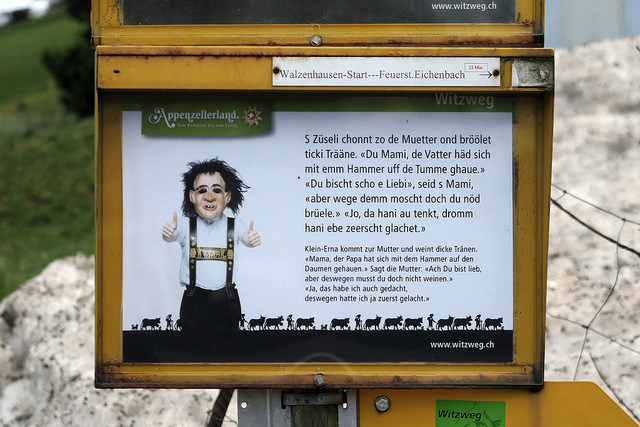
A joke in Swiss German, with the High German translation below (Photo: Kecko/Flickr)

If you’ve been learning German at school, there is mixed news: the situation in German-speaking cantons of Switzerland is more complex.

The mother tongue of Swiss living in these cantons is Swiss German, which is radically different from the German spoken in Germany and Austria (so-called “High German”). In fact, Germans and Austrians usually can’t understand Swiss German at all. Imagine the thickest Scottish brogue you’ve ever heard, double it, and you’ll be getting close to the way Swiss German sounds to speakers of High German.

As an exchange student in a German-speaking canton of Switzerland, you’ll be hearing Swiss German about 70% of the time. Your school lessons should be taught in High German, and news broadcasts are always in High German, but Swiss people talk to each other in Swiss German. When your host families and school friends speak to each other, and when they talk to strangers, they’ll speak Swiss German.

The fact that Swiss people converse in Swiss German, rather than High German, will make it more difficult for you to learn High German. That’s one of the very few drawbacks of undertaking an exchange in Switzerland.

High school in Switzerland

Matterhorn, Switzerland
The Matterhorn (Photo: Transformer18/Flickr)

As an exchange student, you’ll attend a Swiss high school. Each of the 26 cantons in Switzerland has its own education system and there are subtle differences between all of those systems.

However, one common thread is that most cantons have streamed high schools – meaning that students go to different high schools depending upon whether they intend to study at university, or not. It’s most likely that you’ll attend high school attended by students who are bound for university – which are known as Gymnasiums or Kantonsschulen in the German-speaking parts of Switzerland, and lycees or colleges in French-speaking cantons.

Subject choice

High school students in Switzerland study a wide range of compulsory subjects. Even in the final two years of school, it’s normal to study 12 or 13 subjects, which can include multiple languages (including English and Latin), philosophy and multiple science subjects. Teachers teach to a high standard, and have high expectations of students.

As an exchange student, you may have some latitude to sit out some of these subjects, or to attend twice as many classes in particular subjects. If you’re particularly interested in art or music, for example, but haven’t studied philosophy before, you may be able to pick up an extra line of art or music while the rest of your class takes philosophy class.

Attire

Most schools in Switzerland don’t require their students to wear a uniform.

One interesting thing I noted was that most students tended to wear the same thing all week – they’d change their t-shirt but keep wearing the same jeans and sweater from Monday to Friday. So, don’t fret about the need to bring dozens of different outfits to wear to school – four or five sets of jeans and sweaters should be fine.

Extra-curricular activities

Swiss schools offer very few clubs, sports or other co-curricular activities. Instead, most people pursue such interests through local clubs which are known as Vereine in German. There are a large number of Vereine in most areas, offering everything from cycling to pistol shooting to choir singing, so it should be easy for your host family to help you find a Verein to suit your interests.

Social etiquette

There is a bit of a social divide in Switzerland. In general, residents of the German-speaking cantons are more socially conservative, and people in the French-speaking cantons are more liberal.

However, there are a number of common social norms and etiquette that you need to be aware of, as follows:

  • Swiss people are proud to be Swiss and are protective of their culture and national identity. Take care to avoid criticising habits or things about the country you don’t like.
  • The Swiss are extremely punctual. It is considered rude to be late and especially rude to make other people late (for example, when you and your host family are invited to dinner at another family’s house, and you take so much time getting ready that you delay your host family’s departure and make them arrive late).
  • Don’t swear – particularly around your host parents, teachers, and other authority figures. People on exchange in the German speaking parts of Switzerland need to be wary of the word Scheisse. It’s milder than the equivalent English word – in fact, it’s probably closer to crap – and is used more often in daily conversation by native German speakers. However, it is still too impolite to use in front of your host parents or other authority figures.
  • Also, Swiss people are relatively devout, so avoid exclamations like “God!” or “Jesus!”, and avoid being flippant about religion or religious people.
  • In the German-speaking cantons of Switzerland, it’s considered polite to greet people with their names, if you know them. If you see your friend Urs in the street, for example, you need to say “Hoi Urs” (“Hi Urs”), rather than just saying “Hoi”. Some exchange students go for an entire year without realising this, but it’s enough to cause offence.
  • The three main languages in Switzerland – German, French and Italian – all have formal and informal ways of addressing other people. Make sure that you always use the formal when you’re addressing others, unless they are children, members of your immediate host family or schoolmates. Using informal language to address others, such as teachers, shop assistants or adult friends of your host family, can cause real offence.

Money management

Switzerland is famous for its banking sector, and Swiss retail banks are modern and well-organised. Your host parents or exchange organisation will organise a bank account for you.

ATMs are widespread throughout Switzerland, and all major banks offer internet banking. Most Swiss banks also offer accounts which have a Maestro card linked to them. Maestro – owned by MasterCard – is a payment method which works like a credit card, but allows you to use funds from your savings account to pay for purchases, rather than bank credit.

Cost of living in Switzerland

Switzerland is an expensive country in which to live. The cost of living in Switzerland is on par with Japan, Scandinavia and Australia, and is considerably more expensive than the cost of living in the remainder of Europe, North America and South Africa.

When you factor in exchange rates, Switzerland is a hugely expensive place to live.

Thankfully, your host family will help you meet most of your food expenses, and your exchange organisation may help you to meet some of your costs of living. For example, my sponsoring Rotary club in Switzerland used to pay for my monthly bus and train pass.

When you’re out and about, some basic foodstuffs are relatively cheap – such as milk, bread, cheese and chocolate. The two biggest supermarket chains in Switzerland – Migros and Coop – are a good place to grab lunch or a snack at a reasonable price.

Migros and Coop are also probably the best places to buy essentials like shampoo, toothpaste and deodorant. German discount supermarkets Aldi and Lidl have also recently opened in Switzerland, and are a good option for buying your food and toiletries.

What to bring

For some reason, name-brand clothing like Nike or Levis can be very hard to find in Switzerland. When you do find it, the eye-watering prices can put it out of your price-range, anyway. Likewise, cold-weather gear (such as long coats and thermal longs) can be expensive. Stock up on such items before you leave home, or be prepared to give your Amazon account a good workout.

Having said that, there is a mid-priced department store chain in Switzerland called Manor which is a great place to shop for (non-brand name) clothing. Manor sells its own brands and these are generally stylish, last very well, and (by Swiss standards) are reasonably priced. My wife has a pair of winter gloves and some socks which she bought at Manor in Lucerne in 2009, all of which are still going strong after years of wear.

Electronics (iPods, phones, cameras) are generally expensive in Switzerland. Again, you’re better off bringing your own electronic gear rather than planning to buy in Switzerland.

Getting around

Train in Switzerland
Swiss train (Photo: Transformer18/Flickr)

Most exchange students in Switzerland – like most Swiss people – travel using a combination of train and velo (bike).

The Swiss train system is legendary for being fast, clean, efficient, and punctual. Be warned – it is really punctual. If your train leaves at 11.02am, it will leave at 11.02am on the dot and not a second later. You need to be on board. The train network is extensive and will take you to nearly every corner of the country.

For the trip to school or other local journeys, your Swiss host family will probably provide you with a bike. Switzerland has a well-developed network of bike paths and secondary roads which make cycling quite safe and enjoyable. Although Switzerland has a relatively low crime rate, you need to lock your bike up at school and at the train station when you aren’t using it.

Swiss food

Swiss cuisine is delicious and readily palatable for people with Western tastes. As in many other European countries, lunch is the main meal of the day for Swiss people.

Main meals consist of foods such as pasta, schnitzels, pastries, potato dishes (including the noted national specialty, Roesti), and salads. Although Switzerland is most famous for its chocolate and cheese, the fresh bread and yogurt are just as addictive. You have been warned!

Swiss culture

Sport

The Swiss participate in a wide variety of sports. In summer, cycling, swimming and tennis are very popular. Cycling in particular is an ideal sport for exchange students: it’s free, a great way to see Switzerland, and Switzerland has a huge network of safe, well-maintained and signposted bike paths.

In winter, nearly everyone in Switzerland heads to the alps for skiing and snowboarding. Nowhere in Switzerland is more than a couple of hours from a skiing area, and nearly every exchange student ends up going to the snow with his or her host family for at least a couple of days. If you do end up doing snow sports, your host family will be almost certain to have ski or snowboard gear which you can borrow, so there is no need to worry about bringing any of this from home.

Music

Young Swiss people listen to the same kinds of music as audiences in most western nations. Basically, it’s a mix of pop, rock, R’n’B and hip-hop. Most of the songs which are popular in the US and UK will also make it to the radio in Switzerland. Swiss radio also plays German-language songs from Germany and Austria, and French-language music from France.

I found the live music scene to be a little under-developed when I lived in Switzerland. Hopefully, things have improved in the meantime.

Communications

Internet

Switzerland generally has outstanding internet infrastructure. It’s virtually certain that your host family or families will have a good, fast connection that you can use.

Mobile telephones

Switzerland also has excellent cell phone options – numerous providers offering full geographic coverage at low prices. Your host family should be able to help you get connected within your first couple of days in Switzerland.

Climate

Luzern Winter
Lucerne on a Winter’s night (Photo: Christoph Konrad/Flickr)

Switzerland’s climate is similar to the Northeastern United States. Summers can be surprisingly hot and, due to the large number of lakes and rivers in the country, very humid.

Winter is relatively cold – with daytime temperatures close to zero for months on end – but with a small diurnal range. Nighttime temperatures in the Swiss winter are usually nowhere near as cold as, say, Canada or Scandinavia.

Something that takes some getting used to is a wintertime phenomenon called Hochnebel – basically, a layer of cloud which sits 7-800 metres above sea level and which persists for weeks and weeks on end without interruption. You can easily go for a month or more in Winter without seeing the sun.

Risks and hazards

Overall, Switzerland is a very safe country. Crime rates are extremely low – even by European standards – and there are relatively few natural hazards which you need to be wary of.

Even so, you need to exercise prudence and caution as you would in any other country. In particular:

  • Don’t hitchhike or walk alone by yourself by the side of the road at night time.
  • When heading out at night – and particularly when waiting at train stations – try to ensure that you’re with at least one other person at all times.
  • If you are going to be drinking alcohol – particularly larger amounts – make sure that you have a friend with you and a way of contacting your host parents if you get into trouble.
  • When riding your bike after dark – be it coming home from school in Winter, or travelling home from a party late at night – make sure to use a light, and keep off the road if possible.

If you have any questions about going on exchange to Switzerland, please leave them in the comments below. And if you’re planning to go to Switzerland as an exchange student, my book How to Have a Successful High School Exchange contains lessons and advice from my own time in Switzerland which will help to ensure that your exchange is a success.

Good luck,

Matt


How to become a foreign exchange student – your 7-step guide

Rotterdam
Rotterdam, Netherlands (Photo: Kristoffer Trolle/Flickr)

Think that you’d like to become an exchange student, but not sure how to go about it?

Relax. This easy 7-step guide will show you what you need to do to apply successfully and be on your way.

Step 1 – Ask yourself – “do I really want to do this?”

“Look before you leap” is great advice – particularly when you’re deciding how to spend a whole year of your life.

The fact is that being a foreign exchange student isn’t always easy. In fact, most people who go on exchange find it to be one of the most challenging things they’ve ever done.

There are far easier ways to spend a year.

Before you take the plunge and put yourself and your parents through the process of applying to be a foreign exchange student, take the time to find out what is involved in a student exchange, and think very carefully and hard about whether you want to do it.

Visit my guide on what to expect as a foreign exchange student.

Talk to former exchange students about their experiences overseas.

Visit the home pages of a few student exchange organisations, and learn about their expectations and rules.

Above all, make sure that your decision to become a foreign exchange student is an informed one.

Step 2 – Choose a host country

Once you’ve decided to take the big step and apply for a student exchange, you need to think about where you’d like to exchange to.

There are hundreds of countries on earth, but probably only a couple of dozen which are safe and pleasant to live in. You need to be sure that you choose one of the good ones.

Get advice on choosing a safe, rewarding exchange destination at my choosing a host country page.

Also, look at the UN’s Human Development Index. Generally, the countries at the top of that table are the best places to go on exchange to. The countries that score well on the HDI all have stable societies, good healthcare, low crime, and affluent, good-citizen populations. Those are exactly the same features that make a good host country.

Step 3 – Decide on an exchange organization

Once you’ve decided on a destination country, you need to find a reliable, well-run exchange organisation to undertake your exchange with in that country.

Again, there are probably hundreds of student exchange organisations around the world – good, bad and ugly. You need to think very carefully about which one you go with.

The reason is that if something goes wrong – such as a bad host family or a problem with the school you attend – a good student exchange organisation will have the experience and mechanisms to help you deal with the problem quickly and get on with your exchange. They’ll get you settled with a new host family, or moved to a new school.

Do your research. Check out my page on choosing an exchange program for hints and tips on how to find the best exchange organisation to undertake your exchange with.

Step 4 – Write your exchange application

Make no mistake:

There are lots of people want to go on exchange with the best exchange organisations.

There are also lots of people who want to go to the most popular exchange destinations.

If you’re going to get the exchange you want, you need to beat all of those people. And the most important thing you can do to give yourself a chance of beating them is to write a great exchange application.

How do you write a killer written exchange application? My page on writing an exchange application has loads of inside tips for how to write an application that will blow your competition away and help you to go exactly where you want to go. Check it out.

Step 5 – Undertake your exchange interview

The second step to winning your dream exchange is delivering a great student exchange interview.

Let’s face it: nobody likes being interviewed. Even people who’ve been through dozens of job interviews still find it intimidating.

However, there are many things you can do to prepare yourself for your exchange interview. Some of them are mechanical – like being well-rested and arriving at the interview venue in plenty of time. Others require you to undertake research and preparation. With a little forethought and inside knowledge, you can also anticipate some of the questions the interview panel will ask you.

As part of your preparation for your student exchange interview, be sure to visit my detailed article on preparing for your interview.

Step 6 – Prepare for your departure

Been selected to go on exchange? Congratulations.

While that’s great news, the work isn’t over yet. In fact, it’s really only just begun.

There are a huge number of  things that you need to take care of before your departure date. You need to organise travel insurance. You need to get your passport, visa and other paperwork sorted out. Booking flights, making contact with your host family…the list goes on and on.

Your exchange organisation will help you to get organised and should provide you with a checklist of things to take care of. I’ve also prepared a comprehensive “to-do” list discussing all the things you need to think about doing prior to departure, and the order you should do them in. Go take a look.

Step 7 – Get off to a great start

You know that first impressions really matter. But the odds are that you’ve also never been an exchange student before. How do you make a good first impression and get off to a good start with your host family and school colleagues?

There are a number of things you can do during your first weeks as an exchange student that will help you set a solid foundation for the remainder of your exchange. With some care and thought, you can make a great first impression on your classmates and host family that will pay big dividends later on.

My page on making a good first impression is full of actionable tips to help you manage the transition to being an exchange student, and help you make friends and fit in during your first couple of weeks.

Good luck,

Matt